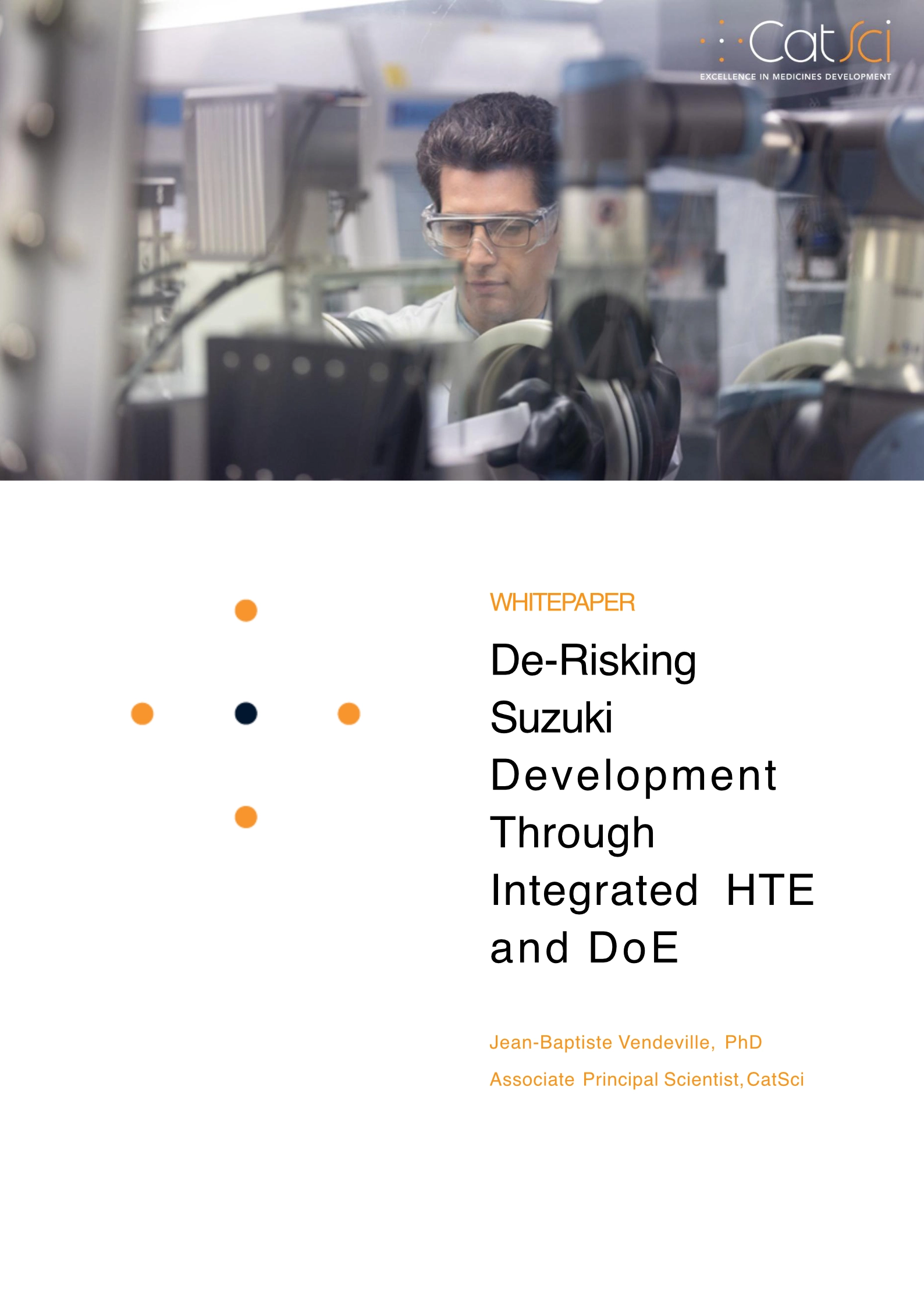
Many process development challenges begin long before manufacturing. Limited exploration of reaction space, inconsistent experimental execution and tools that aren’t designed for solvent-based chemistry can make it difficult to translate promising screening results into scalable processes.
High-throughput experimentation paired with Design of Experiments helps address these challenges, but success also depends on automation designed specifically for chemistry workflows.
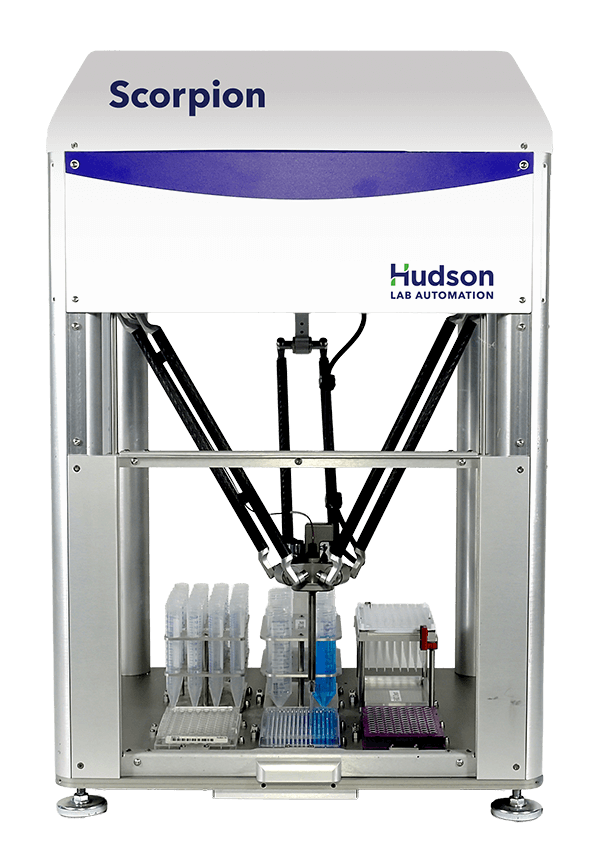
The Scorpion™ liquid handler was designed specifically for chemistry applications, providing the flexibility needed for HTE workflows, reaction optimization and process development where traditional biological liquid handlers often fall short.
Traditional liquid handlers are designed for biological workflows—not chemistry.
| Capability | Traditional Liquid Handlers | Scorpion |
|---|---|---|
|
Solvent compatibility |
Limited |
Broad |
|
Volatile reagents |
Challenging |
Supported |
|
Fume hood operation |
Rare |
Yes |
|
Workflow flexibility |
Fixed |
High |
|
Suitability for HTE chemistry |
Limited |
Optimized |
Scorpion is designed specifically for HTE chemistry workflows, enabling consistent performance from screening through scale-up.
CatSci evaluated automation platforms capable of supporting demanding chemistry workflows, particularly those involving diverse solvents and safe operation within laboratory environments.
“Most automation platforms struggle in chemistry workflows due to solvent variability and safety constraints.
Scorpion stood out for its ability to operate in a fume hood, handle diverse solvents, and deliver consistent performance from screening through scale-up.”
— [Rob Crook, Technical Director, CatSci]
or
— [Jean-Baptiste Vendeville, Associate Principal Scientist, CatSci]
Beyond technical capability, the CatSci team also highlighted how quickly Scorpion integrated into existing laboratory workflows.
“Scorpion was easy to integrate into our workflow and quick for the team to adopt. Its flexibility across solvents and conditions made it a strong fit for our chemistry applications.”— [Scientist Name, CatSci]
The CatSci study illustrates that successful scale-up is driven by more than experimental design alone. Combining high-throughput experimentation with statistical optimization and automation designed specifically for chemistry creates a more efficient and reproducible development process.
The result is faster optimization, reduced scale-up risk and greater confidence that promising reactions can successfully transition from screening into production
CatSci Ltd is a CRO specializing in small molecule process development. Their expertise in HTE, DoE, catalysis, and reaction optimization enables rapid, scalable progression from early screening to manufacturing.
High-throughput experimentation (HTE) is a process development approach that rapidly evaluates many reaction conditions in parallel, allowing chemists to optimize reactions using less material and significantly less time than traditional experimentation.
HTE enables chemists to screen catalysts, ligands, solvents and reaction conditions simultaneously, helping identify robust reaction conditions before scaling to larger batch sizes.
Design of Experiments (DoE) is a statistical methodology that evaluates how multiple reaction variables interact, allowing scientists to optimize chemical processes using fewer experiments while improving reproducibility.
Unlike biological liquid handlers, chemistry automation systems must tolerate aggressive solvents, volatile reagents, inert atmospheres and operation inside fume hoods while maintaining precise liquid handling performance.
Copyright 2026 ® Hudson Lab Automation
Get the details in "Adaptable Automation for Rapidly Changing Labs"